
Smoking a turkey on a pellet grill is one of the easiest ways to put a better bird on the table. The grill holds the temperature for you, the hardwood pellets add real smoke flavor, and your oven stays free for the sides. The two things people get wrong are the smoker temperature and the internal temperature, so this guide covers both in detail, plus timing, bird size, prep, pellets, and how to get skin that isn't rubbery.
The short answer: Smoke a turkey on a pellet grill at 275°F for good smoke flavor and reasonable timing, or at 300°F–325°F if crispy skin matters most. Plan on roughly 20–25 minutes per pound at 275°F and about 15 minutes per pound at 325°F. The turkey is done when it reads 165°F in the thickest part of the breast and the innermost part of the thigh and wing. Rest it 20 minutes, then carve.
Smoked Turkey Cheat Sheet
| Question | Answer |
|---|---|
| Best smoker temperature | 275°F for most cooks. 300°F–325°F for crispier skin. The USDA says to keep a smoker between 225°F and 300°F the whole time. |
| Safe internal temperature | 165°F, checked in the thickest part of the breast and the innermost part of the thigh and wing |
| Time per pound | About 30–40 min at 225°F, 25–30 min at 250°F, 20–25 min at 275°F, about 15 min at 325°F |
| Best turkey size | 12–14 pounds. Above about 16 pounds, spatchcock it or cook it in parts |
| Stuffing | Don't stuff a smoked turkey. Cook stuffing separately |
| Rest time | 20 minutes before carving |
| Best pellets | Milder woods like apple, cherry, pecan, or a blend |
What Temperature to Smoke a Turkey
Turkey isn't brisket. It's lean, tender meat that doesn't need 12 hours to break down, so smoking it "low and slow" at 225°F mostly just adds time and leaves you with soft, rubbery skin. That's why turkey usually does better at a higher temperature than you'd use for brisket or pork butt.
The USDA's guidance on smoking meat and poultry says to keep the smoker between 225°F and 300°F for the entire cook. Here's how each turkey smoking temp plays out:
| Pellet Grill Temp | Approx. Time per Pound | 12-lb Turkey | What You Get |
|---|---|---|---|
| 225°F | 30–40 minutes | 6–8 hours | Heaviest smoke flavor, longest cook, soft skin |
| 250°F | 25–30 minutes | 5–6 hours | Strong smoke, skin still on the soft side |
| 275°F | 20–25 minutes | 4–5 hours | Best balance of smoke, timing, and juicy meat |
| 300°F–325°F | About 15 minutes | About 3 hours | Crispiest skin, lighter smoke, fastest cook |
These times are estimates. Wind, outside temperature, how often you open the lid, and how cold the bird is when it goes on all change the clock. Cook to internal temperature, not time.
Our Recommendation: 275°F, or Start Low and Finish Hot
If you want one number, set the pellet grill to 275°F and leave it there. If you want more smoke and better skin, run it at 225°F–250°F for the first hour or two while the bird takes on smoke, then raise it to 300°F–325°F to finish. Most pellet grills make more smoke at lower set temperatures, so the early low stage is where the flavor goes on.
Smoked Turkey Internal Temperature
A turkey is safe to eat at 165°F. That's the safe minimum internal temperature for all poultry on the FoodSafety.gov temperature chart, and it doesn't change because the bird was smoked instead of roasted.
The USDA says to check it in three spots:
- The thickest part of the breast. This is usually the last spot to get done and the easiest to overcook.
- The innermost part of the thigh, close to the body but not touching bone.
- The innermost part of the wing.
Keep the probe off the bone. Bone heats differently than the meat around it and can throw off the reading.
Breast vs. Thigh Temperature
White meat and dark meat finish differently. The breast is at its juiciest right around 165°F and dries out quickly after that. Dark meat has more fat and connective tissue, so many cooks prefer thighs in the 175°F range for texture. That's the target in our holiday BBQ temp chart too. A leave-in probe in the breast and a quick check of the thigh with an instant-read thermometer is the easiest way to manage both.
Don't Trust the Pop-Up Timer
If your turkey came with a pop-up indicator, the USDA still recommends checking the breast, thigh, and wing with a food thermometer. Pop-ups are not a substitute for a real reading.
What Size Turkey Is Best for Smoking?
Smaller is better. A 12- to 14-pound turkey cooks evenly and gets through the temperature danger zone (40°F–140°F) in a reasonable time at smoker temperatures. USDA-based extension guidance lists turkeys 16 pounds or less as the recommended size for safe smoking.
Feeding a big crowd? Smoke two smaller birds instead of one 22-pounder, or spatchcock it. Removing the backbone and flattening the turkey cuts the cook time way down and evens out how the breast and thighs finish. We cover the method and the best grills for it in Best Smokers for Spatchcock Turkey.
Plan on about 1 pound of whole turkey per person, which is what the USDA uses for planning.
Before You Smoke: Thaw, Don't Stuff, and Brine
Thaw It Completely
The USDA says to fully thaw meat and poultry before smoking. A turkey that's still frozen in the middle will sit in the danger zone far too long at smoker temperatures. The safest method is the refrigerator, at about 24 hours for every 4–5 pounds:
| Turkey Weight | Fridge Thawing Time |
|---|---|
| 4–12 pounds | 1–3 days |
| 12–16 pounds | 3–4 days |
| 16–20 pounds | 4–5 days |
| 20–24 pounds | 5–6 days |
Short on time? Thaw it in cold water in a leak-proof bag, changing the water every 30 minutes and allowing about 30 minutes per pound. Cook it right away once it's thawed. Never thaw a turkey on the counter.
Don't Stuff a Smoked Turkey
The USDA advises against stuffing a turkey you're going to smoke. At smoker temperatures, the stuffing inside the cavity can take too long to reach 165°F. Bake your stuffing in a pan, or try our Thanksgiving BBQ recipes and holiday sides on the grill. You can put aromatics like onion, lemon, garlic, and herbs in the cavity for flavor.
Dry Brine or Inject
Turkey is lean, so a little help with moisture and seasoning goes a long way:
- Dry brine: Rub kosher salt (and any seasoning you like) all over the turkey and under the skin, then refrigerate it uncovered for 24–48 hours. It seasons the meat and dries the skin, which is the single biggest help for crispy skin on a smoker.
- Injection: An injectable marinade puts flavor and moisture deep into the breast. Our smoked turkey breast recipe uses Blues Hog Rise and Brine, and it works the same way on a whole bird.
- Wet brine: It works, but it takes a lot of fridge space and tends to give you softer skin. Most people smoking on a pellet grill are happier with a dry brine.
If you brined the bird, use a low-salt or salt-free rub so it doesn't come out too salty.
How to Smoke a Turkey on a Pellet Grill, Step by Step
- Thaw and prep. Make sure the turkey is fully thawed. Remove the neck and giblets from both cavities and pat the bird dry with paper towels.
- Brine or season. Dry brine 24–48 hours ahead, or inject and season the day of. Rub softened butter or oil under and over the skin, then add your rub.
- Fill the hopper. A turkey cook runs 3–6 hours or more, so start with a full hopper of fresh, dry pellets. Yoder estimates its pellet grills burn about 1.5–4 pounds per hour depending on temperature and weather.
- Preheat the grill. Set it to 275°F (or 225°F–250°F if you're doing the low-then-hot method) and let it come fully up to temperature with the lid closed.
- Probe and load the turkey. Put a leave-in probe in the thickest part of the breast, away from bone. Set the bird breast-side up on the grate. A drip pan underneath keeps the grill clean and catches drippings for gravy.
- Keep the lid closed. Every time you open it, you lose heat and add time. Let the controller do its job and watch the probe from your phone or receiver.
- Finish hot for crispy skin. If the skin is still pale and soft when the breast hits about 145°F–150°F, raise the grill to 325°F for the rest of the cook.
- Check in three spots. When the leave-in probe reads 165°F, confirm the breast, the innermost thigh, and the wing with an instant-read thermometer. Any spot under 165°F means it goes back on.
- Rest, then carve. Move the turkey to a cutting board and let it stand 20 minutes. That lets the juices settle so they stay in the meat instead of running all over the board.
Refrigerate leftovers within 2 hours. Slice or cut the meat into smaller portions first so it cools quickly.
Best Wood Pellets for Smoked Turkey
Turkey has a mild flavor and soaks up smoke easily, so it's easy to overdo it with a strong wood. Milder woods are the safe bet:
- Apple: Light and slightly sweet. Hard to overdo.
- Cherry: Mild, slightly fruity, and gives the skin a deep mahogany color.
- Pecan: A step up from fruitwood, nutty and rich without being harsh.
- Blends: A hickory or oak blend with fruitwood gives you more smoke without the bitterness of straight mesquite.
We carry Lumberjack Pellets in Apple, Cherry, Pecan, Hickory, Oak, Mesquite, and Competition and Supreme blends.
How to Get Crispy Skin on a Smoked Turkey
Rubbery skin is the most common smoked turkey complaint. The fixes:
- Dry the skin. Dry brine it uncovered in the fridge, and pat it dry before it goes on.
- Cook hotter. Skin needs heat to render. At 225°F it rarely gets there. Finishing at 300°F–325°F makes a big difference.
- Use fat. Butter or oil on the skin helps it brown.
- Skip the mopping. Spritzing or basting adds moisture to the surface and works against crispy skin. Save the spritz for ribs and pork butt.
- Don't foil-wrap it on the grill. If the breast is getting too dark before the thighs are done, tent just the breast loosely with foil.
Common Smoked Turkey Mistakes
- Cooking by the clock. Time charts are for planning. A thermometer decides when it's done.
- Smoking a huge bird whole. Over about 16 pounds, spatchcock it or smoke two smaller turkeys.
- Going too low. Running below 225°F keeps the turkey in the danger zone too long. Stay inside the USDA's 225°F–300°F smoker range or roast-level heat at 325°F.
- Not planning extra time. Give yourself a 45- to 60-minute buffer. A turkey that finishes early holds fine tented with foil. One that's late holds up dinner.
- Running out of pellets. Check the hopper halfway through. A pellet grill that runs out loses its fire and its temperature.
Pellet Grills and Gear We Recommend for Turkey
These are pellet grills and tools we sell and stand behind. If you're still deciding between a pellet grill and gas, start with Pellet Grill vs. Gas Grill, or browse all of our smokers and pellet grills.

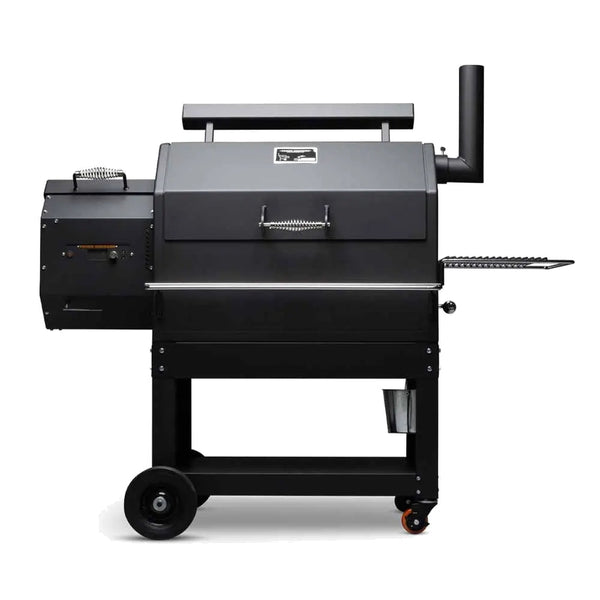
Yoder Smokers YS640S — Best for Big Holiday Cooks
A heavy-steel, made-in-the-USA pellet grill that holds temperature through wind and cold. It sets from 150°F to 600°F in 5-degree increments, has 1,070 square inches of total cooking space, a 20-pound hopper, and a probe access port. There's plenty of space for a big holiday cook. $2,699.99

Green Mountain Grills Peak Prime 2.0 — Best Value for a Whole Turkey
A full-size pellet grill under $1,000 with a 150°F–550°F range, Wi-Fi control through the GMG app, and windows in the lid and hopper so you can check the bird and your pellets without opening anything. $999.00

FireBoard Spark Instant-Read Thermometer — For the Three-Spot Check
A fast Type-K thermocouple instant-read that's accurate to ±0.7°F in the cooking range and comes with a NIST-traceable calibration certificate. It also accepts a leave-in FireBoard probe and connects over Wi-Fi and Bluetooth, so one tool can watch the breast during the cook and check the thigh and wing at the end. $149.00

Lumberjack Pellets, 20 lb — Cherry, Apple, or Pecan for Turkey
Lumberjack makes its pellets from whole harvested logs instead of sawdust left over from other manufacturing, which it says keeps more of the wood's natural flavor. Grab a bag in Cherry, Apple, or Pecan for your bird. $13.99

Blues Hog Rise and Brine — Injectable Marinade
An injectable poultry marinade that pushes flavor and moisture into the thickest part of the breast, where turkey dries out first. $11.95
Frequently Asked Questions
What temperature should I smoke a turkey at?
Smoke a turkey at 275°F for the best balance of smoke flavor, cook time, and juicy meat. If you want crispier skin, run the pellet grill at 300°F–325°F or finish there. The USDA recommends keeping a smoker between 225°F and 300°F for the whole cook.
What internal temperature is smoked turkey done?
Smoked turkey is done at 165°F. Check the thickest part of the breast and the innermost part of the thigh and wing with a food thermometer, and make sure every spot reads at least 165°F. Many cooks like thighs closer to 175°F for texture.
How long does it take to smoke a turkey on a pellet grill?
Plan on about 20–25 minutes per pound at 275°F, so a 12-pound turkey takes roughly 4–5 hours. At 325°F it's closer to 15 minutes per pound, or about 3 hours. At 225°F it can take 30–40 minutes per pound. Always cook to 165°F, not to a time.
Is 225°F too low to smoke a turkey?
225°F is the low end of the USDA's safe smoker range, so it's safe if your grill holds it steadily, but it's not ideal. The cook takes much longer and the skin usually comes out soft and rubbery. 275°F or hotter gives better results on poultry.
Should I brine a turkey before smoking it?
Brining helps, since turkey is lean. A dry brine (salt rubbed on and left uncovered in the fridge for 24–48 hours) seasons the meat and dries the skin for better crisping. Injecting a marinade is a faster option the day of the cook.
Can you smoke a stuffed turkey?
No. The USDA advises against stuffing a turkey you're going to smoke, because the stuffing in the cavity can take too long to reach a safe 165°F at smoker temperatures. Cook the stuffing separately and fill the cavity with aromatics like onion, citrus, and herbs instead.
What are the best pellets for smoking a turkey?
Mild woods work best on turkey: apple, cherry, and pecan are the most popular. Cherry also gives the skin a rich mahogany color. Strong woods like straight mesquite can overpower poultry, so if you want more smoke, use a hickory or oak blend with fruitwood.
Should I smoke a turkey breast-side up or down?
Breast-side up is the standard on a pellet grill. Pellet grills cook with indirect, circulating heat, and the fire pot sits under a heat baffle, so there's no direct flame hitting the bird. Breast-side up also lets the breast skin brown and crisp.
Get Your Turkey Setup at Our Phoenix Showroom
Need a pellet grill, a better thermometer, or a bag of cherry pellets before Thanksgiving? Stop by Over the Fire BBQ Supply at 21443 N 23rd Ave, Suite 2, Phoenix, AZ 85027, or call us at (602) 345-1659. The Over the Fire team can help you pick the right grill and walk you through your first turkey.